
Getting fields ready: What hay producers should be doing now
This post was originally published on this site.


(Rural Roots Canada) – For hay producers across Canada, the window between the spring thaw and first cut is short. What happens in those early weeks can shape the quality and quantity of every bale that comes off the field for the rest of the season.
Chris Ennis, an agricultural field product specialist with Kubota Canada, says the most common and most costly mistake he sees is skipping field preparation altogether.
“If we don’t see those ruts repaired, fixed, replaced, we’re going to be running into things,” Ennis said, adding that overlooked winter damage can drive up ash content in feed and directly harm forage quality.
Ennis walked through the full hay-making process, from the first pass across the field in spring through baling. He said the process starts with a close look at winter kill, surface damage from frost or early-season livestock grazing, compaction and drainage issues.
He suggests producers keep an eye on drainage problems in the fall, when pooling water is easier to spot after the crop has been removed. Addressing those issues before spring reduces one more thing to manage during a busy season.
“The fall is the best time when you’re going to notice,” Ennis said. “With those fall rains, we’ve taken that crop off, and we can see where that water is pooling.”
The right tool depends on how much work the field needs, Ennis says. A standard harrow, such as Kubota’s Great Plains CT8300 series, which runs from 18 to 60 feet, is built for light surface work. Breaking up residue, spreading manure from overwintered livestock, and opening up thatch to let air and nutrients back in.
“It’s a very passive tool,” he said. When fields have heavier rutting, washouts, or need to be transitioned to a new crop, Ennis recommends Kubota’s power harrow lineup. Ranging from eight to 20 feet, these tractor-powered implements use rotating tines to break up lumps of soil and leave a fine seedbed ready for planting.
Nutrient management is another area where Ennis sees more producers investing in their own equipment. With urea prices up roughly 12 per cent in the past month alone, he says precision matters. Kubota’s disc spreader lineup, including the DSX and DSM series, supports prescription mapping, allowing operators to vary application rates based on soil test results and put fertilizer exactly where it is needed.
“We need to be very frugal with how we want to manage that,” he said.
For mowing, Kubota offers disc mower conditioners in a range of configurations. Ennis said conditioning preference varies by region. On the East Coast, he sees more demand for tined conditioners, which are gentler on leafy forage. Roller conditioners are a better fit for older or tougher crops, where the crimping action speeds up dry-down without shredding too much leaf material.
Larger butterfly mower setups, where a front-mounted unit and a rear mower work together to cover more ground in a single pass, can cut a width of more than 33 feet at once.
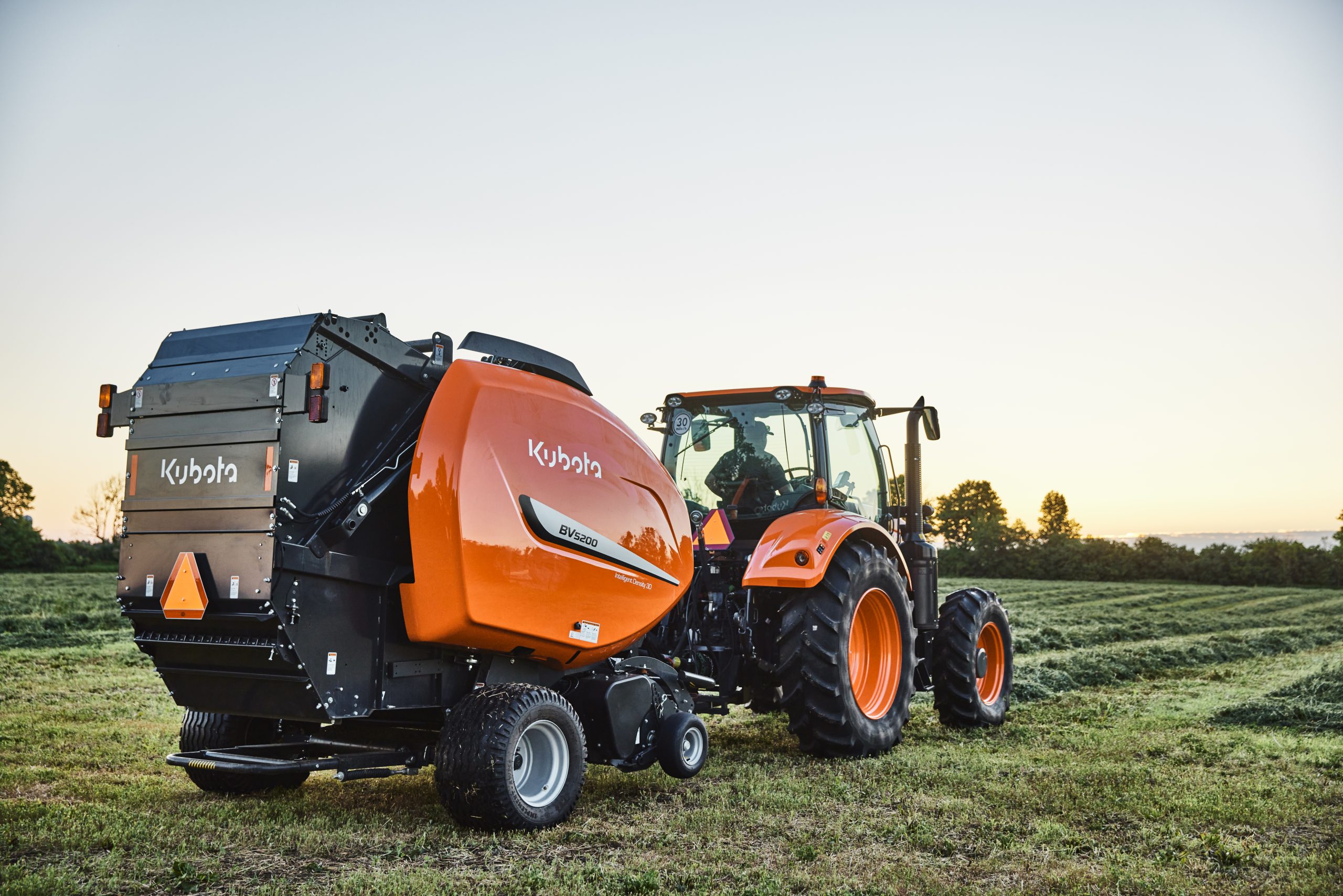
If one feature stands out to Ennis, it is the 3D density system on the BV5160 4’ variable chamber baler. The system allows operators to set three separate core pressure adjustments within a single bale, giving them control over how tight or loose different zones of the bale are packed. That flexibility matters for single-spear handling, where a softer core makes for cleaner pickup.
The BV5160, Kubota’s four-foot baler, offers two super-cut options for chopping crop down before it enters the bale chamber, which is useful for producers running a total mixed ration. For those who prefer un-chopped bales, a power feed rotor intake uses 14 guided rotor fingers to move crop into the chamber evenly, producing consistent bales without the irregular density that can come from an uncontrolled feed. The baler also features a drop floor system, which moves out of the way if a slug of crop gets stuck, avoiding the unplugging work that Ennis notes tends to happen at the worst possible moments.

“It doesn’t happen on a nice, cool day,” he said. “It happens on the hottest dusty day that we’re out there.”
One of the newer additions to Kubota’s hay tool lineup is a power merger series. Available in configurations from a 3.8-metre front-mount unit up to an 11-metre Trailed model. Ennis said taking a 30-foot swath and combining it into a single well-ventilated windrow cuts down on fuel, field compaction, and tram line damage.
Equipment readiness, Ennis said, matters just as much as field prep. Getting equipment into a dealership for a service check before the season starts keeps things running when every day in the field counts.
“When you get in that field, you know that you’re going to be getting as much uptime as you can,” he said. “With all the rising input costs, we need our return on investment to be as close as we can.”
Photo Courtesy: Kubota Canada
The post Getting fields ready: What hay producers should be doing now first appeared on Rural Roots Canada.